
hpdrivers.net is an independent website and is not affiliated with, endorsed by, or sponsored by HP Inc. Download links point to HP's official servers (ftp.hp.com). Learn more

Driver Is Unavailable on an HP Printer: Causes and Fixes in Windows

When Windows lists your HP printer with the status “Driver is unavailable”, the message is about the driver attached to the printer entry, not about the printer’s hardware. Windows has a printer queue with that name, but no working driver is connected to it. This guide goes through the causes in the order that is quickest to check, including one that Microsoft has documented for several HP models and that most guides skip.
Last checked against Microsoft’s and HP’s published support information: October 31, 2026 · Checked by H&G
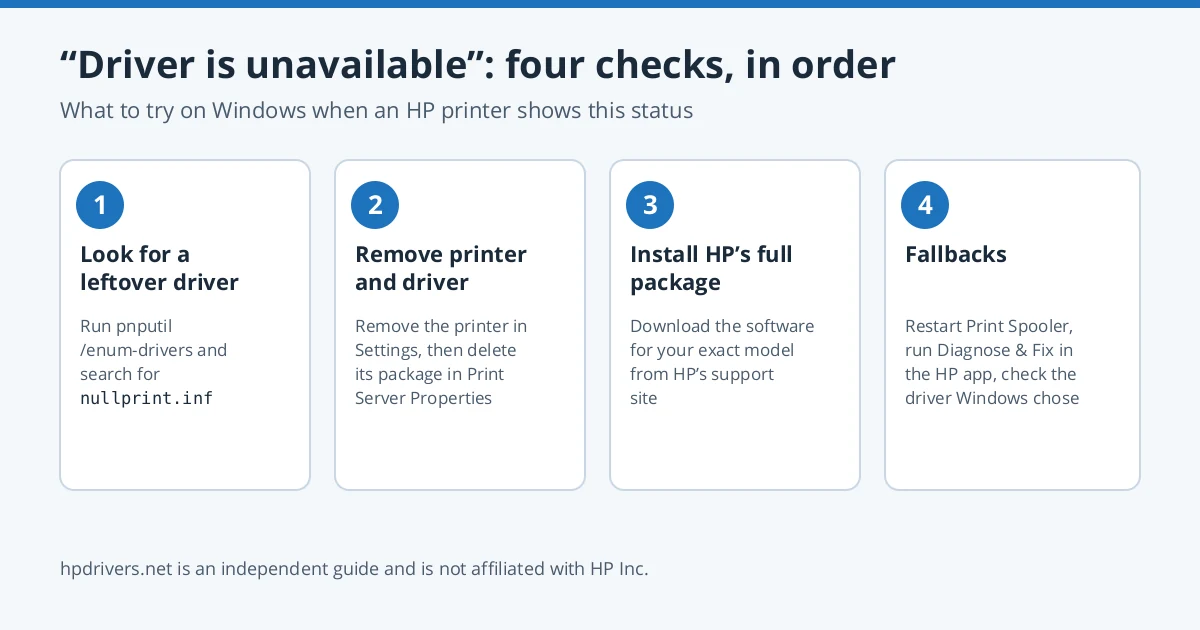
Four-step checklist for the HP printer message Driver is unavailable on Windows

The short version

  1. Check whether a leftover “Null Print” driver (nullprint.inf) is blocking the real driver. The check only lists drivers, so it is safe to run.
  2. Remove the printer, then remove its old driver package as well.
  3. Install the full software package for your exact model from HP, not only what Windows picks automatically.
  4. Only then try fallbacks: restarting the Print Spooler, or the generic driver.

What it looks like when the driver is unavailable

You will see it in the status column under Devices and Printers in Control Panel, where a working printer normally shows “Ready.” Printing usually fails, and removing and re-adding the printer can bring the same message back. That repeat is the clue: Windows keeps attaching the same broken driver entry.

Step 1: Look for the leftover “Null Print” driver

Microsoft has acknowledged that some HP printers can end up in the “Driver is unavailable” state after the printer is uninstalled. According to Microsoft, the current HP driver for these models also installs a file called a “Null Print” driver. When the printer is uninstalled, that file stays behind. When the printer is added again, Windows treats the file as the printer’s driver and stops looking for the real one.

Microsoft’s answer lists these affected models, and says the list is not complete: HP DeskJet 4670, ENVY 5000, ENVY 5660, ENVY Photo 7800, OfficeJet 3830, OfficeJet 5740, OfficeJet Pro 8600 and OfficeJet 8730. The note was written for Windows 10 in 2019. The same commands exist in Windows 11, and we have not seen Microsoft update the note, so treat it as a check that may or may not apply to your printer.

  1. Type cmd in the taskbar search box, right-click Command Prompt, and choose Run as administrator.
  2. Run pnputil /enum-drivers. This only lists the driver packages on your PC.
  3. Scroll through the list and look for an entry whose Original Name is nullprint.inf. If there is none, this is not your problem. Go to Step 2.
  4. Note the Published Name of that entry (for example oem12.inf).
  5. Run pnputil /delete-driver <published name>, replacing the placeholder with the name you noted.
  6. Remove your HP printer and add it again. Windows should now search for the proper driver.

Delete only the entry whose Original Name is nullprint.inf. Do not remove other packages from that list.

Step 2: Remove the printer and its old driver package

Removing only the printer leaves the driver package in Windows. A damaged or outdated package can then be reused the next time you add the printer.

  1. Open Settings > Bluetooth & devices > Printers & scanners, select the HP printer and choose Remove.
  2. Press Windows + R, type printui /s /t2 and press Enter. This opens Print Server Properties on the Drivers tab.
  3. Select the old driver entries for your HP printer, choose Remove, and pick the option to remove the driver and driver package.
  4. Restart Windows.

Step 3: Install the full package for your exact model

A Windows-supplied driver often covers only basic printing. In one Microsoft Q&A thread about this message, an independent adviser gave the same answer and sent the user to HP’s full feature software for the printer. Use HP’s driver download page and search for the exact model name, for example “OfficeJet Pro 8600” rather than “OfficeJet.” Different HP families use different packages.

If you use the printer on more than one PC, install the software on every PC where you see the message. One report describes a printer that worked over USB on one laptop but showed “Driver is unavailable” over Wi-Fi on a second laptop that had no HP software installed. For installation details see our guide to installing an HP printer driver.

Step 4: If it still fails

  • Restart the Print Spooler. Open Services, find Print Spooler, and restart it. If jobs are stuck, HP has a page on fixing a print job stuck in the queue.
  • Run HP’s Diagnose & Fix. It is the tool HP now recommends instead of the discontinued Print and Scan Doctor. See our page on the replacement.
  • Check which driver Windows chose. On Windows 11, newer printers may be installed with the built-in Microsoft IPP Class Driver, and Windows Protected Print Mode can limit third-party drivers. Our Windows 11 HP printer driver guide covers both.

Frequently asked questions

Does “Driver is unavailable” mean my printer is broken?

The message describes the driver attached to the printer entry in Windows. By itself it does not say the printer hardware has failed.

Why does the message come back after I remove and re-add the printer?

Because removing the printer does not necessarily remove the driver package or a leftover nullprint.inf entry. Windows can attach the same entry again.

Is deleting nullprint.inf safe?

It is the step Microsoft’s own answer describes for this problem. Run the listing command first, delete only the entry whose Original Name is nullprint.inf, and only if you see it.

Where do I get the right driver?

From HP’s driver download page for your exact model. hpdrivers.net is an independent website. Our model pages link to HP’s own servers.

Source for the Null Print behaviour: Microsoft Q&A, “Unable to install HP Printer. Status shows as ‘Driver is unavailable’” (answer dated February 21, 2019).

How to Install an HP Printer Driver on Windows and Mac

Last updated: October 29, 2026 · Written by H&G

This guide covers the steps that are the same for most HP printers: choosing the right package, connecting the printer, and installing the driver on Windows or a Mac. Each printer page on hpdrivers.net adds the notes that are specific to that model, such as when to plug in the USB cable.

1. Find the right download

  • Check the exact model. The model name is printed on the front or top of the printer and on the label at the back. “M404dn” and “M404dw” can share a driver page, but an M404 and an M428 cannot.
  • Check your Windows version. Press Win + R, type winver and press Enter. Almost all current PCs run 64-bit Windows.
  • Pick the package type. A full software package installs the driver plus HP’s setup and scan tools. A driver-only package installs just the print driver. Driver files without an installer are meant for Windows’ Add Printer wizard.

2. Connect the printer

USB

Many HP installers ask you to plug in the USB cable during setup, not before. If the installer says so, leave the cable unplugged until it asks. If the cable was already connected and setup can’t find the printer, unplug it, restart the installer and connect it when prompted.

Network (Ethernet or Wi-Fi)

Connect the printer to the same network as the computer before you start the installer. For Ethernet, plug the printer into your router or switch. For Wi-Fi, use the printer’s control panel or HP’s setup tool to join your network. Printing a configuration or network page from the printer shows its IP address, which helps if the installer can’t find it.

3. Install on Windows

Full or driver-only package (with installer)

  1. Close other programs and turn the printer on.
  2. Run the downloaded .exe file. It extracts itself and starts the installer.
  3. Follow the on-screen steps and choose USB or network when asked.
  4. Print a test page when setup finishes.

Driver files without an installer

  1. Run or unzip the download to extract the driver files to a folder.
  2. Open Settings → Bluetooth & devices → Printers & scanners (Windows 11) or Settings → Devices → Printers & scanners (Windows 10) and choose to add a printer.
  3. Choose the option to add the printer manually, then select the port or enter the printer’s IP address.
  4. When Windows asks for a driver, choose Have Disk and browse to the extracted folder.

4. Install on a Mac

For most current HP printers, HP’s Mac download is HP Easy Start or the HP app. They find the right software for your model and walk you through setup. Many HP printers also support Apple AirPrint: in that case you can add the printer in System Settings → Printers & Scanners without installing anything. Each printer page shows what HP lists for macOS.

5. If it doesn’t work

  • The printer shows as offline. Check that the printer and computer are on the same network, then restart the printer, the computer and the router.
  • Windows installed its own driver. Windows sometimes adds a basic driver automatically. If features are missing, install HP’s package from the printer page; it replaces the basic driver.
  • The installer stops or fails. Try the driver-only package for your printer, or the HP Universal Print Driver if HP lists it for your series.
  • An old driver causes problems. Remove the printer in Printers & scanners, restart, then install the current package.

HP Universal Print Driver (UPD) Download for Windows 11, 10 and 7

Last checked against HP’s download list: October 26, 2026 · Checked by H&G

The HP Universal Print Driver (UPD) is one Windows driver that works with a large number of HP LaserJet and other business printers. HP lists it as a download for hundreds of printer series. This page collects the current UPD packages HP publishes, with direct links to HP’s own server.

Most people need this one

Windows 11 (64-bit): UPD PCL 6Version 8.2.0.26819 · Released Sep 26, 2026 · 20.2 MB

Download

Windows 10 and Windows 7 (64-bit): UPD PCL 6Version 8.2.0.26778 · Released Sep 26, 2026 · 20.3 MB

Download

Files download directly from HP’s official server (ftp.hp.com). hpdrivers.net does not host or modify them.


Which UPD package should you download?

HP splits the UPD into separate packages. Pick one by answering three questions:

  • Which Windows? HP publishes one build for Windows 11 and another for Windows 10 and Windows 7.
  • Which processor? Most PCs are x64 (Intel or AMD). Choose ARM64 only for Windows on ARM devices, such as laptops with Snapdragon processors. HP’s ARM64 packages are listed for Windows 11 only.
  • PCL 6 or PostScript? PCL 6 is HP’s default and the right choice for everyday office printing. Choose PostScript only if your printer supports it and your software needs it, for example some design and publishing programs.

All current HP Universal Print Driver downloads

Package Windows Version Released Size
UPD PCL 6 (x64)

File details

File: upd-pcl6-win11-x64-8.2.0.26819.zip

Windows 11 8.2.0.26819 Sep 26, 2026 20.2 MB Download
UPD PostScript (x64)

File details

File: upd-ps-win11-x64-8.2.0.26819.zip

Windows 11 8.2.0.26819 Sep 26, 2026 21.4 MB Download
UPD PCL 6 (ARM64)

File details

File: upd-pcl6-win11-ARM64-8.2.0.26778.zip

Windows 11 8.2.0.26778 Sep 26, 2026 20.1 MB Download
UPD PostScript (ARM64)

File details

File: upd-ps-win11-ARM64-8.2.0.26778.zip

Windows 11 8.2.0.26778 Sep 26, 2026 21.5 MB Download
UPD PCL 6 (x64)

File details

File: upd-pcl6-win10-x64-8.2.0.26778.zip

Windows 10, Windows 7 8.2.0.26778 Sep 26, 2026 20.3 MB Download
UPD PostScript (x64)

File details

File: upd-ps-win10-x64-8.2.0.26778.zip

Windows 10, Windows 7 8.2.0.26778 Sep 26, 2026 21.5 MB Download

Older PCL 5 driver

HP still lists an older UPD PCL 5 package (version 6.1.0.20062, November 2015, Windows 7 64-bit) for a few older printer series. It is no longer developed. Use it only if an old printer or program specifically needs PCL 5: upd-pcl5-x64-6.1.0.20062.exe (18.9 MB).

UPD or your printer’s own driver?

If HP publishes a full software package for your exact printer, that package is usually the easier choice for a single home or office printer, because it can also install scan software and setup tools. The UPD makes more sense when:

  • you manage many different HP printers and want one driver for all of them;
  • HP lists only the UPD for your printer on your version of Windows (this is common on Windows 11 for older LaserJet models);
  • the model-specific package won’t install, and you only need to print.

Each of our printer pages shows whether HP lists the UPD for that series.

How to install the UPD

  1. Download the package that matches your Windows version and processor.
  2. Extract the ZIP file to a folder.
  3. Run the installer in the extracted folder, or add the printer with Windows’ Add Printer wizard and choose Have Disk, pointing it to that folder.

For more detail, see our guide to installing an HP printer driver.